
【Quantum Physics】【Yuki KAWAGUCHI】Predicting new physical phenomena, theorizing unknown behavior in ultracold atomic gases

Yuki KAWAGUCHI (Ph.D.)
Professor, Condensed Matter Engineering Group, Department of Applied Physics, Graduate School of Engineering, Nagoya University
—
Prof. Kawaguchi conducts research in theoretical physics, focusing on topics such as ultracold atomic gases, topological magnetic structures, and superfluidity and superconductivity. In particular, she has received several awards for her theoretical research on ultracold atomic gases with internal degrees of freedom, including the Award for Science and Technology (Research Category), conferred by the Minister for Education, Culture, Sports, Science and Technology.
—
Temperatures cannot fall below absolute zero, -273.15 degrees Celsius, a realm of complete stillness. As temperatures approach it, strange things occur that defy our everyday intuition. For example, helium is a light and stable gas commonly used in balloons: no matter how much pressure is applied, it will never become a liquid at room temperature. However, it becomes a liquid at -269 °C, and when cooled further by about two degrees Celsius, it exhibits new properties, such as the ability to “climb” the walls of the container and to pass through gaps only a few atoms wide. These are manifestations of superfluidity—the ultimate free-flowing state with zero friction.
“I found this fascinating. It’s one of the reasons I chose this research area,” says Prof. Kawaguchi.
How do atoms behave at extremely low temperatures? Exploring this question is fascinating in itself, and demonstrating it experimentally is equally compelling. On the other hand, as an undergraduate, she often struggled with setting up experiments and found it difficult to carry them far enough to analyze the underlying physics. “In those days, I was eager to enjoy the core mystery that physics had to offer,” says Prof. Kawaguchi. Her decision to pursue theoretical physics stemmed from the pleasure she found in deep reflection. Theoretical physicists, such as Albert Einstein, use established laws, working hypotheses, and experimental data to predict new phenomena and to explain experimental results beyond the scope of existing theories.

Attractive research in atomic gases at the crossroads of theory and experiment
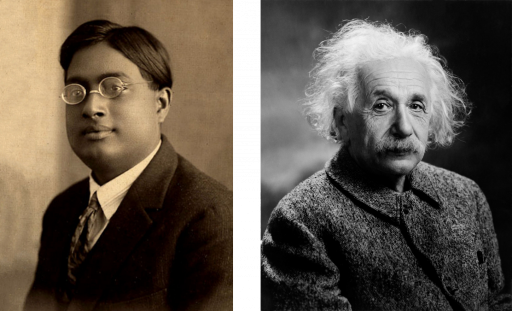
Theoretical physics and experimental physics are inseparable. New theories guide the direction of subsequent experiments, whose results in turn lay the foundation for future theories. When Prof. Kawaguchi entered university, the development of techniques for trapping and cooling atoms made it possible to reach temperatures as low as one ten-millionth of a degree Celsius above absolute zero. This technological advance led to the experimental realization of a Bose-Einstein condensate (BEC), which had been theoretically predicted by Einstein in 1925 based on the quantum statistics formulated by Satyendra Nath Bose—some 70 years earlier.
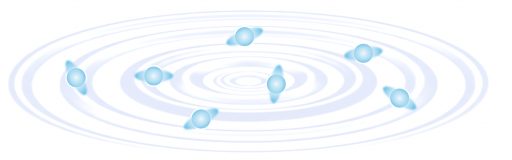
To gain an intuitive understanding of BEC, let us take rubidium as an example. Rubidium is a solid at room temperature and produces vapor when heated to about 100 °C. Under ordinary cooling, gaseous rubidium first condenses into a liquid and then solidifies again. However, when the gas density is reduced to about one hundred-thousandth of that of air, the gas can remain in the gaseous phase even at temperatures very close to absolute zero. Such a low density is achieved by trapping atoms in a vacuum using magnetic fields, preventing them from sticking to the container walls. At extremely low temperatures, even more striking phenomena occur; one such phenomenon is Bose-Einstein condensation. Gaseous rubidium atoms move independently yet exhibit coherent behavior through quantum statistics. As the temperature decreases, these quantum correlations extend over long distances and become more pronounced. As a result, the atoms behave not only as particles but also as waves—one of the defining features of quantum physics. In BEC experiments, which are conducted in carefully controlled and isolated environments, it is possible to observe the quantum nature of atoms in a state close to their fundamental form.
Prof. Kawaguchi says: “Atomic gases are amazing. One fascinating aspect is that they allow us to explore parameter regimes that are inaccessible in conventional experimental settings.”
Let us briefly turn to another area of research related to superconductivity. Generally, superconductivity requires a metal or compound to be maintained at an extremely low temperature. For example, in maglev trains, niobium-titanium alloy used as a superconductor must be cooled to -269°C to create powerful electromagnets that levitate the vehicles. If superconductivity could be realized at higher temperatures, much closer to those of daily human activity, it would have an enormous impact. High-temperature superconductivity has long been a scientific dream, yet it remains unrealized. This naturally raises a fundamental question: how high-temperature superconductivity can be realized under ideal conditions. An experiment using atomic gases demonstrated that a state analogous to superconductivity can emerge at relatively high temperatures by tuning interatomic interactions. In electronic systems, this would correspond to temperatures of around 1,000°C. Needless to say, such results do not directly lead to high-temperature superconductivity because real materials involve many additional constraints and complexities. Nevertheless, the experiment provides valuable insight into the fundamental physics and allows researchers to develop new theoretical frameworks, thereby guiding future experimental studies.
Prof. Kawaguchi: “Atomic gases contain no impurities. In a clean environment, they allow us to design experiments exactly as in theoretical models. It’s quite exciting when you can perfectly align experiments with theories.”
Tackling new theoretical challenges
In 2005, a paper was published reporting the successful creation of a BEC using chromium, an element previously considered difficult for BEC experiments. Chromium is a familiar element, commonly found in stainless steel. It possesses an unusually strong magnetic property—each atom behaves like a tiny magnet. This pronounced property made chromium particularly attractive for exploring new quantum phenomena. Meanwhile, a new method had been developed to capture gaseous atoms at extremely low temperatures. In earlier experiments, magnetic traps forced the tiny magnets of atoms to align in the same direction. The new optical trapping method uses laser beams to trap atoms, removing the constraint imposed by magnetic fields. Freed from magnetic constraints, the tiny magnets of chromium atoms can now orient themselves, governed by their intrinsic interactions. What new quantum phenomena could ultracold atoms reveal?

(R) Atoms captured by an optical trap: lasers are shone from two directions, capturing atoms at their intersection. Free from magnetic constraints, the tiny atomic magnets can orient in any direction.
Prof. Kawaguchi: “What kinds of structures emerge from the collective motion of individual particles? I find that it’s great fun to ask such questions, regardless of their immediate scientific importance.”
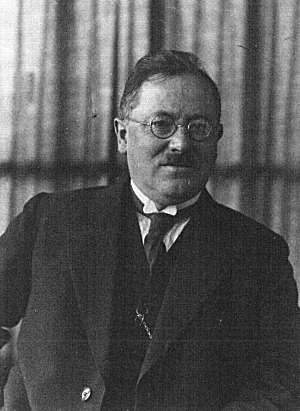
While discussing these ideas with her colleagues, Prof. Kawaguchi began theoretically investigating the phenomena that might emerge when a chromium BEC was combined with optical trapping. She focused on the Einstein-de Haas effect, a gyromagnetic phenomenon first reported in 1915 by Einstein and Wander de Haas, which was demonstrated experimentally at the time, albeit only approximately. To put it simply, the effect can be understood by imagining an electromagnet made of an iron rod with a coil wound around it. When the direction of the electric current is reversed, the north and south poles of the electromagnet flip, causing the rod to rotate. This phenomenon shows that changes in the direction of iron’s tiny atomic magnets can be converted into mechanical rotation. Then, what would happen if the same principle were realized not in a solid piece of iron, but in a quantum gas composed of freely moving atoms?
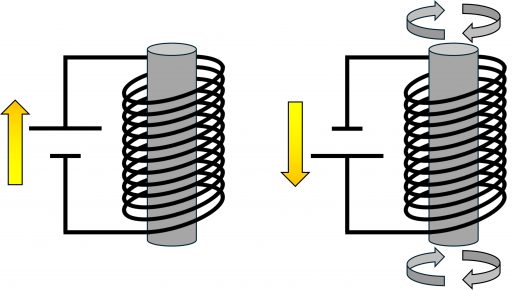
When she revisited the role of magnetism in theoretical studies of atomic gases, she encountered unexpected obstacles, beyond the already complex mathematics, requiring approaches far more ingenious than originally anticipated.
Prof. Kawaguchi: “I carried out the calculation while mentally visualizing the physical phenomena that must be occurring. Without this kind of conviction, it would have been impossible to continue. I encouraged myself, telling myself that I was definitely moving in the right direction.”
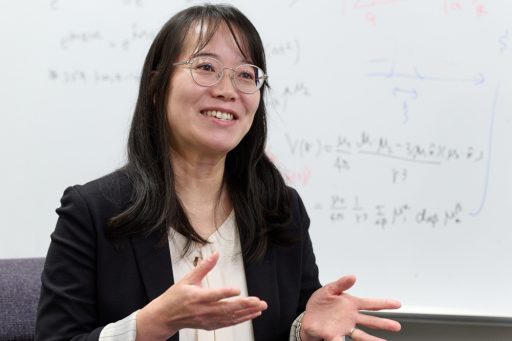
After about six months, Prof. Kawaguchi finally completed her theoretical calculations and simulations. Just then, she faced an unforeseen challenge. A paper presenting an idea similar to hers appeared as a preprint before undergoing formal peer review. Reading it, she realized that, although it pursued a similar idea, its content was less rigorously structured than hers. Yet, she knew that if she fell behind, her work might be seen as derivative—something she could not accept. She had only one week to complete her paper and establish the originality of her idea. After a whirlwind week, on November 2, 2005, she submitted her paper to Physical Review Letters, an American Physical Society journal. The paper, “Einstein-de Haas Effect in Dipolar Bose-Einstein Condensates (1),” was published on March 3, 2006, an unforgettable milestone in her research career.
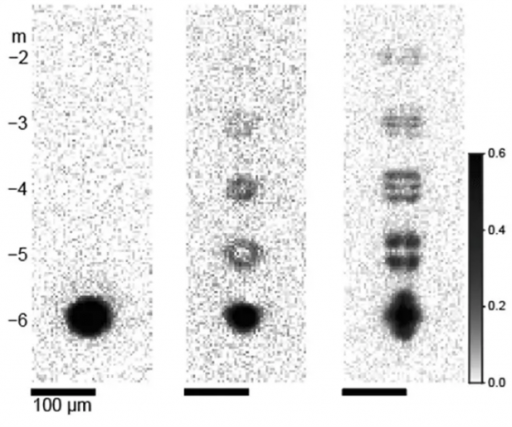
In summary, her paper describes how individual chromium atoms behave collectively when a uniformly applied magnetic field is suddenly turned off. The mathematical analysis shows that the gas begins to circulate, representing the Einstein-de Haas effect, and that, as a consequence of its quantum nature, it forms a quantized vortex. The formation of such a vortex should be accompanied by a distinctive hole at its center.
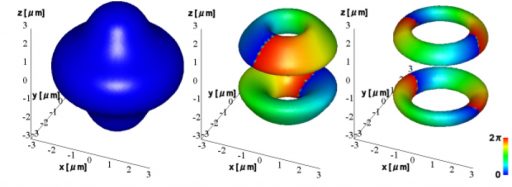
“In fact, it has now been confirmed experimentally,” says Prof. Kawaguchi.
Almost 20 years after its publication, her prediction was experimentally demonstrated (2). The experiment was by no means easy to carry out. To enhance the magnetic effects, the researchers used europium atoms, which are more magnetic than chromium atoms. Even so, the magnetic field generated by the gas as a whole was only about one ten-thousandth as strong as the Earth’s magnetic field. The experiment required extraordinarily demanding measures, including constructing all components from non-magnetic materials and creating a space shielded with extreme precision from external magnetic fields—on top of the already formidable challenge of controlling an ultracold atomic gas. These efforts required years of work and enormous dedication, clear evidence that Prof. Kawaguchi’s paper was recognized as being worthy of such commitment.
(1) Einstein–de Haas Effect in Dipolar Bose-Einstein Condensates; Yuki Kawaguchi, Hiroki Saito, and Masahito Ueda; Physical Review Letters. 2006, 96, 080405
(2) Observation of the Einstein–de Haas effect in a Bose–Einstein condensate; Hiroki Matsui, Yuki Miyazawa, Ryoto Goto, Chihiro Nakano, Yuki Kawaguchi, Masahito Ueda, Mikio Kozuma; Science. 2026, 391, 384-388.
(3) “Atomic spins set quantum fluid in motion” (Institute of SCIENCE TOKYO;
https://www.isct.ac.jp/en/news/y4riu9qihv5b)
Working toward predictions beyond the realm of atomic gases
What abilities are required of theoretical physicists?
Prof. Kawaguchi says: “I believe researchers must be able to visualize the physical phenomena they are concerned with, especially in three dimensions. Mathematical formulas alone are merely symbols and lines of code. One must be careful not to lose sight of the underlying physics. If you can explain what is really happening—and why—behind the mathematical expressions, then you can be confident with your results.”
Prof. Kawaguchi continues her research, hoping to turn what is now considered mysterious into established understanding.
“I would like to make predictions beyond atomic gases that can contribute to other fields as well. For example, in ordinary solid crystals, electrons and atoms are affected by various factors such as heat transport, electric currents, and control by light, electric fields, or magnetic fields in extremely complex ways. However, I believe that by carefully investigating how individual mechanisms operate and work together—through experiments in which these factors can be controlled as precisely as we do with atomic gases—we may uncover entirely new phenomena.”
(Interview and Text: Tatsuro AYATSUKA, Interview Date: October 22, 2025)