
【Robotics】【Toshio FUKUDA】Continuous Research and Development by Curiosity and Human Connection -Aiming for the Development of Robots and Coexistence with People
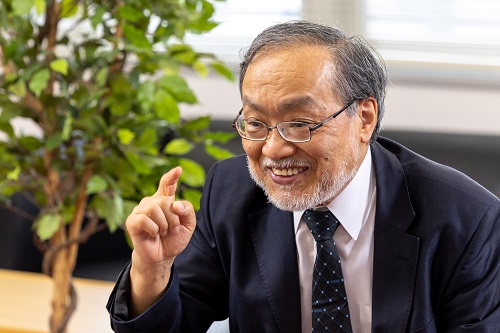
Toshio FUKUDA
——
In 2020, he became the first Japanese member to be named President of the Institute of Electrical and Electronics Engineers (IEEE), one of the largest international professional associations for electronic engineering and electrical engineering. He also currently serves as the Program Director for Goal 3 of the “Moonshot Research and Development Program” initiated by the Cabinet Office, which envisions a future in which humans and robots coexist in harmony. He is an advocate of multiscale robotics and has a wide range of research interests. His laboratory has produced 105 PhD candidates to date. He specializes in robotics.
——
Curiosity and the commonality of physical laws that enable the development of multiscale robotics
ゆく川のながれは絶えずして、しかも、もとの水にあらず
淀みに浮ぶうたかたは、かつ消えかつ結びて、久しくとどまりたるためしなし
* The above Japanese passage describes how “A river flows continuously, and not a single drop of water flowing through it remains the same. A bubble floating in stagnant water repeatedly disappears and is reborn.”
It compares the concept of everything perpetually changing (impermanence) to the flow of a river.
This is a passage from the Hojoki, written by KamonoChomei, famous historical essayist. It is one of Dr. Fukuda’s favorite quotes and seems to aptly describe his continuous research and development. Dr. Fukuda says, “If you stay in the same study for even one year, it will be a thing of the past.” He has worked on pipe-inspection robots, clustering self-organizing distributed robots “CEBOT,” and brachiation robots that move like gibbons—a never-ending list. Based on the concept of multi-scale robotics, in which research and development are vertically conducted from the nanoscale to the macroscale, he has developed numerous technologies and robots.
What is the driving force behind his research and development? Part of its essence can be seen in the episode when he developed a micro-gripper, which was initiated in the 1980s. This delicate technology, which made it possible to grip micro-sized objects, attracted attention as a revolutionary idea at the time.
“It started out as a hobby. It’s an interest in grasping a small object.”
One day at lunchtime, Dr. Fukuda was rowing a boat in the moat of a park. Looking into the water, he unexpectedly saw many small creatures, including mosquito larvae. He scooped up a cup of water and brought it back to the lab, where he immediately looked at it under a microscope. He noticed that there were many organisms there, including vorticellae. Although he thought instantly, “I want to grab hold of them,” of course neither his fingers nor tweezers would fit into the prepared specimen. It was at this time that he pondered whether there was any way to grab hold of them, and this was the beginning of a new development.
A power source to “move a thing only a little” is essential for gripping a small object. Using a motor did not work because it caused too much movement to grab a small object well. He heard about a power source called piezo (piezoelectric element); however, it was expensive and difficult to obtain at the time. In the midst of this situation, through his senior’s connections, he learned that a prototype of a small actuator (a mechanism for converting energy into power) had been developed using another micro technology. He immediately visited the researcher who developed it. Fortunately, he was able to share about 20 of these devices. The displacement that this small actuator could move was only 4 micrometers. By making use of the principle of leverage, he made it possible to adjust the movement to 40 micrometers, and to 400 micrometers. Thus he was able to invent a micro-gripper, with the world’s best capability of grasping small objects at the time.
The research and development that originated from this is extensive. Attachment of a sensor to its tip made it possible to measure the width of the object displacement and the softness of the object, in addition to gripping it. It would also be possible to manipulate a single cell and precisely apply a physical stimulus to it. Eventually, offers for joint research began to come in, leading to the development of micro-grippers that could be used under vacuum conditions and to the application of microcatheters that could move inside blood vessels.
Dr. Fukuda speaks of these potential applications as follows.
“When improving the micro-gripper, for example, I considered a variety of actuators, including those made of shape memory alloys and polymer materials, those operated hydraulically and others that I had never dealt with before. All of these are in accordance with the fundamental physical phenomena. Even if they are dealt with by different research fields, they are all the same. It is often the case that what was not useful in other research fields is useful in my field.”
Through a genuine curiosity to grip something small, and as a result of nurturing this curiosity without giving up, a new field of microtechnology has blossomed. The commonality of physical laws serves as a hub for applications in other fields. This sequence of events is probably one of the driving forces behind his ideas, which are connected without stagnation.
A new world of research created by human connections
Of course, his ideas do not only come from his inner curiosity. He said that the impetus for his research and development had often came from connections with people. One example is the development of carbon nanotube processing technology. He learned about carbon nanotubes by talking to Dr. Yahachi Saito and Dr. Hisanori Shinohara, a leading nanocarbon researcher at Nagoya University.
“Carbon nanotube researchers focused their attention on unraveling the true nature of carbon nanotubes, including their physical properties. However, my interest was in how to manipulate and process them.”
For Dr. Fukuda, the electron microscope was not an observation tool, but an experimental tool. In the late 1990s, he began to embark on research and development. He continued his research to develop a nano-robotic manipulator that works well in the confined space of an electron microscope, to improve the electron microscope itself and to develop a processing method using oxygen gas, which eventually enabled the measurement, processing and assembly of materials at the nanoscale.
Furthermore, since there was no forum for the presentation of such groundbreaking results at that time, Dr. Fukuda took the initiative to establish a new forum for presentation and discussion called the Nanotechnology Council within the IEEE in 2002. He pioneered the field of nanotechnology research that is done from the standpoint of robotics research.
“The new field was gaining worldwide recognition, and at one point so many students and researchers gathered at my lab that they could not enter. Every day our research received positive feedback. It was a really good time.”
Creating a relationship where people and robots can learn from each other in order to coexist in harmony
How will robots and their technologies evolve in the future? And how will they integrate into our human society?
Goal 3 of the Moonshot Research and Development Program, for which Dr. Fukuda currently serves as the Program Director, is aimed at developing new, never-seen-before AI robots by 2050. For example, a robot that can autonomously learn, make decisions and adapt to its environment even in places it has never been before. It will be useful on the moon, at disaster sites and in other places where people cannot directly enter. Other examples include a robot that can understand human emotions and ethics and grow together with people. The keywords in development are “co-evolution” and “self-organization.” The key to development is the “technology in which AI technology and robot technology work together to autonomously improve their performance” and the “AI and robot technologies that self-modify their own knowledge and functions.”
Before they can be developed and applied to society, of course, many challenges must be overcome. For example, the introduction of AI robots also raises ethical issues. As a starting point for thinking about this issue, I would like to quote the “Three Laws of Robotics” that appear at the beginning of Isaac Asimov’s science fiction novel “I, Robot.”(1)
First Law: A robot may not injure a human being or, through inaction, allow a human being to come to harm.
Second Law: A robot must obey the orders given it by human beings except where such orders would conflict with the First Law.
Third Law: A robot must protect its own existence as long as such protection does not conflict with the First or Second Law.
The Three Laws of Robotics are summarized as necessary for autonomous robots to coexist with humans. Then, how should they be written to the robot and executed by the robot?
First, the current state of the art is not capable of writing the Three Laws of Robotics into the foundation of all controls and protecting them from tampering. Also, will robots be able to correctly identify “harm” to humans? In the first place, have people themselves been able to define what “harm” is? Thus, in addition to the technical aspects, there are also issues that we as humans will not be able to solve unless we are deeply engaged in protecting our own lives and livelihoods.
“For the coexistence of humans and robots, it is important that there is a balance between the two. Of the various perspectives, including hardware and software, even some should be symmetrical in function between humans and robots. Humans make robots smarter. Humans also learn from robots. I believe that we need to create a cross-learning relationship.”
Research and development of AI robots and our society will continue to change like the flow of a river. Dr. Fukuda’s facial expressions and every word he said powerfully emphasized that an interesting future will come after overcoming challenges one by one from a starting point of fully accepting these changes.
(1) “I, Robot—the Definitive Edition”
Isaac Asimov (Author) / Fusa Obi (Translator) / Hayakawa Publishing Corporation / Publication date: August 6, 2004
(Interview and Text: Tatsuro Ayatsuka, Interview Date: September 13, 2022)