
【Modern Japanese Literature】【Yuko IIDA】Recognizing Social Norms through Literature Fields -To Select Better Norms in an Ever-Changing Era
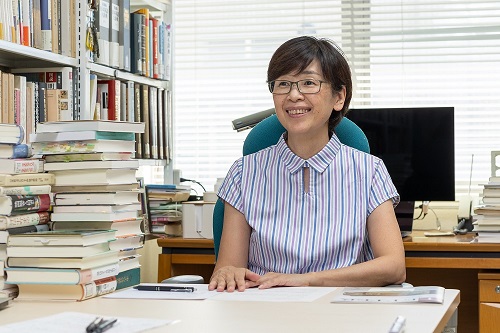
Yuko IIDA
Professor, Japanese Culture Studies, Graduate School of Humanities, Nagoya University / Director, Center for Transregional Culture and Society, Graduate School of Humanities, Nagoya University
—–
She has published many works, including 彼女たちの文学:語りにくさと読まれること (single-authored); 女性と闘争:雑誌「女人芸術」と一九三〇年前後の文化生産 (authored and compiled); and ケアを描く:育児と介護の現代小説 (co-authored). Her new work, プロレタリア文学とジェンダー:階級・ナラティブ・インターセクショナリティ (authored and compiled), was published on October 24, 2022. She presently works in a wide variety of fields, as indicated by her serving as the Director of the Center for Transregional Culture and Society and organizing the international symposium The Ethics of Care and the Humanities on January 28 and 29, 2023. She specializes in modern and contemporary Japanese literature and gender studies.
—–
What Is the Silent Power That Controls Us? The Pursuit of Research to Find the Answer
We live with various social labels attached.
– Students of the natural sciences are good at thinking logically. Students of the humanities have high-level communication skills.
– Stable jobs with lifetime employment are popular. Starting a business and working freely is also good as a modern style.
Although we are not sure if they are true or not, we often hear many other similar examples. These labels affect us as norms for living even before we realize it. Prof. Iida describes it in the following way:
“We all live in ignorance of norms. I feel that it is important to visualize and be conscious of norms. If they are correct, we should maintain them, and if they are incorrect, we can disregard them.”
However, how should we perceive norms, which can be described as “implicit dynamics”? One of the approaches is analysis from the perspective of literature research.
In the late 1980s, a cultural research approach began to be incorporated into Japanese literature research. For example, a novel by a writer is read by many people, such as the editor, critics, and general readers, while influencing society and undergoing evaluation, which in turn influences the writer. Novels are therefore creations not only based on the writer’s own views, but also based on the influence of society as a whole. Called the “literature field,” this entire process is acknowledged as an element that forms culture. A close analysis of the literature field enables a complex entanglement of the norms in society to be unraveled and visualized.
What is the “Literature Field,” Which Reflects and Forms Society?
Let’s take a look at proletarian literature, which is one of Prof. Iida’s research areas and a major trend in modern literature.
The Meiji, Taisho, and Showa periods saw dramatic progress in the modernization of Japan. Textiles, mining, shipbuilding, and many other industries supported the development of Japan in those days, but at the time, they required a large amount of cheap labor. Consequently, the structure of economic disparities became conspicuous, as expressed by the terms “bourgeoisie of the capitalist class” and “proletariat of the wage-earning class.” Under these circumstances, proletarian literature emerged with the theme of the harsh working environment of the proletariat and invited empathy from many people. This literature gained momentum especially in the 1920s and the 1930s, including the renowned work 蟹工船 (The Crab Cannery Ship) by Takiji Kobayashi.
Proletarian literature has been a popular research theme. Prof. Iida, who has incorporated the perspective of gender into the research, says:
“For gender research, it is important to look not only at gender, but also at connections with other elements.”
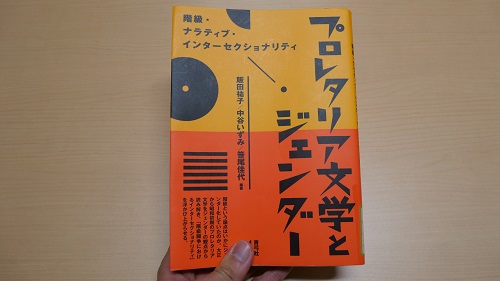
Gender refers to the socially and culturally formed sex, rather than the biological sex. A gender perspective has been woven into each of education, work, public service, etc. The structure and true problems of gender will remain obscure if the relevant elements are simply identified and categorized. They will become explicit only after holistic consideration is given to their backgrounds and surroundings. Prof. Iida has given such consideration in プロレタリア文学とジェンダー 階級・ナラティブ・インターセクショナリティ,(1) authored and compiled by her and other literature researchers.
Those who challenged capitalism and fought for socialism and communism in those days were subject to imprisonment as “thought” criminals. Among them were some proletarian writers, including Takiji Kobayashi. Some citizens tried to provide relief to such imprisoned fighters by, for example, providing them with relief items, visiting them in prison, and offering support for their families.
For these relief efforts, women played the main role in a practical sense. However, public documents only record that men took the lead in the relevant relief organizations, almost without reference to the women’s efforts. In this regard, literature research first highlights the reality hidden in the male gender norms of the time. For example, proletarian writers Shigeharu Nakano and Rintaro Takeda, who authored 病気なほる and 暴力, respectively, depict women engaged in relief efforts in their novels. In one of her works, Prof. Iida says:
“Based on the gap between the public record and reality, I would like to indicate that unlike the public record, the relief narrative represented by proletarian literature features women as the main players in the relief efforts. […] Women, who do not appear in the public record, are portrayed in literature.” (2)
In the structure of reality, there were gender norms of the “fight” as the central part played by men and of the “relief” as the peripheral part played by women. This theory is supported by the description of Tefu Watanabe, the “mother” of the relief efforts, as the symbol of the efforts. She is described in 残された前衛の家族はどうしてゐるか? by Misao Hata, published in the issue of March 1930 of the literature magazine 戦旗, along the following lines:
“She always smiles as if she had completely forgotten about the sadness of her son having been XX. She is working as hard as the young, big Seki-san. She is exactly like the mother of Pavel in Mother by Gorky. She is the mother of the proletariat. […] If any of you are about to feel depressed or intimidated even slightly, you should go there quickly and have a bowl of ramen noodles.”(3)
Tefu Watanabe, who worked hard and made every effort to support the imprisoned fighters and their families, was often featured in proletarian literature magazines. Meanwhile, interestingly, she was at first described as a victim who had lost a family member in the midst of the fighting, namely a person to be relieved. A message to her was published in 同志×野からお母さんへ in the July 1929 issue of 戦旗:
“Ms. Watanabe, please don’t cry when you come to see me. […] There are a lot of things to be done, including those that you can do. I hope that you will visit everyone and console them. Please do not think only about yourself but about everyone.”(4)
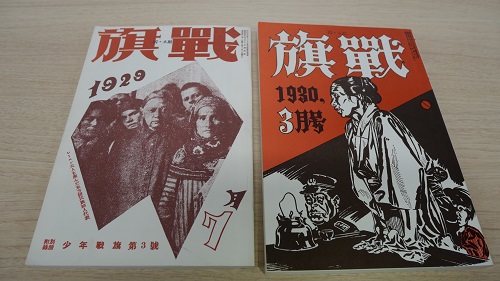
Tefu Watanabe, a mother in deep sorrow due to the loss of a family member, was gradually becoming transformed from a person to be relieved to the key player in the relief efforts. In one of her works, Prof. Iida discusses this transformation along the following lines:
“Due to these dual features, the family grief and predicament served as rhetoric that mobilized citizens to be engaged in the relief efforts. Tefu Watanabe played a symbolic role in this process. (5)
To add momentum to the gender norm of the “fight” as the central part played by men, women placed in the peripheral were depicted differently depending on the purpose. To emphasize the necessity of relief, women were sometimes described with the focus on their family members who should be relieved and the women’s predicament. At other times, women were depicted to encourage others to become committed as backup supporters. Prof. Iida says:
“Literature, especially novels, are based on a framework of thought which includes views about the family and society. Literature reflects and also forms society. ”
The views described here are only a small part of her work プロレタリア文学とジェンダー, which we strongly recommend to you.
(1) プロレタリア文学とジェンダー:階級・ナラティブ・インターセクショナリティ
Yuko Iida (auth. and comp.), Izumi Nakatani (auth. and comp.), and Kayo Sasao (auth. and comp.), Seikyusha, released at bookstores on October 24, 2022
ISBN978-4-7872-3514-5
(2) Authored by the same persons as (1), p. 87 and p. 89
(3) Misao Hata, 残された前衛の家族はどうしてゐるか?, 戦旗, March 1930 issue Senkisha, p. 179 (Note: Primary citation from プロレタリア文学とジェンダー)
(4) 同志×野からお母さんへ, 戦旗, July 1929 issue, Senkisha, p. 127 and p. 129 (Note: Primary citation from プロレタリア文学とジェンダー)
(5) Authored by the same persons as (1), p. 85
How Should We Behave When Norms Are Continuing to Change?
From the modern era to the contemporary era, many literature works present the norms of each period. For such norms, Prof. Iida feels something through her research. She says:
“History shows that norms have always been changing, and I feel that they will surely continue to change.”
Gender norms will also surely change in line with the times. Today, people have begun to search for their ideal selves as men and women, and even various identities that cannot be simply categorized as men or women. If there are old-fashioned systems and approaches that disregard this trend, they need to be changed. Prof. Iida says:
“I don’t feel that the framework of gender will or should cease to exist. However, I believe that discrimination caused by the framework should be eliminated. It would be nice if we could just accept diverse people as they are. People have traditionally fallen into various categories, such as age, origin, class, ethnicity, and race. Among these, gender figures very strongly. I feel that it would be good if gender were diluted by many other attributes.”
(Interview and Text: Tatsuro Ayatsuka, Interview Date: September 26, 2022)