
【Cancer Immunology】【Hiroyoshi NISHIKAWA】Be sincere and persistent in the face of mystery – Challenge of elucidating sophisticated immune responses against cancer
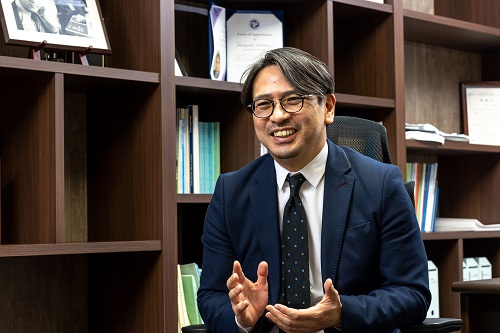
Hiroyoshi NISHIKAWA
Professor of the Department of Immunology, Nagoya University Graduate School of Medicine, and also Chief of the Division of Cancer Immunology, Research Institute/Exploratory Oncology Research & Clinical Trial Center (EPOC), National Cancer Center
—–
In 2022, Dr. Nishikawa was honored as one of the Highly Cited Researchers 2022 by Clarivate Analytics for a third consecutive year, following his recognition in 2020 and 2021. He continues to be a leader in the field of cancer immunology.
—–
Don’t pretend to understand what you don’t understand.
Dr. Nishikawa said that his early work, conducted more than 20 years ago, still serves as the cornerstones of his current research.
“I was lucky to have experienced that work at the beginning. When something happens that I never expected, I can think that there’s only so much wisdom I can have, and there’s still so much I have yet to learn,” he said.
Our body’s immune system plays a crucial role in not only fighting against bacteria and viruses but also eliminating cancer. Dr. Nishikawa started his research in the field of cancer immunology in the late 1990s, when the focus was mainly on the study of killer T cells, which directly attack cancer cells.
At that time, he thought that immunity was not so simple and decided to focus his research on helper T cells, which were recognized as coordinating the immune response. However, at the time, it was believed that helper T cells only assisted killer T cells in their fight against cancer, although much remained to be understood. He divided mice with cancer into several groups and treated them in different ways:
- Activation of killer T cells only
- Activation of helper T cells only
- Activation of both killer and helper T cells
- No treatment
He expected that mice with activated killer T cells and/or helper T cells would have better prognoses although to varying degrees; but unexpectedly, mice with only activated helper T cells showed cancer progression.
Why? Though he later noticed the fact during the days of research, CD4-positive T cells, to which helper T cells belong, can actually be further classified. In reality, in addition to helper T cells supporting killer T cells in fighting cancer, another subset of CD4-positive T cells called “regulatory T cells” also exist. They play a different role by putting the brakes on killer T cells’ attacks. Immunity is such a powerful mechanism that once it gets out of control, it may cause excessive immune responses in the body. Regulatory T cells constantly monitor and control the immune system to prevent immune responses from getting out of hand.
Cancer can manipulate and exploit immune suppressive cells including regulatory T cells as a clever mechanism to evade attacks by the immune system. This mechanism may explain the results of his early research described above, in which treatment intended to activate helper T cells also activated regulatory T cells, unexpectedly leading to the protection of cancer cells. In fact, the two types of T cells work in balance with each other. CD4-positive T cells should not be lumped together as helper T cells only. The expected outcome would not be seen unless the two subsets of CD4-positive T cells are activated differently.
Dr. Shimon Sakaguchi, Specially-appointed Professor of Osaka University, discovered regulatory T cells in 1995. At the time, Dr. Nishikawa struggled with mysterious results, turned to Dr. Sakaguchi’s research on regulatory T cells, thinking that it could be the key. Thus, he found the key to the solution and eventually paved the way for cancer immunology research.
He said, “Actually, immunology was my least favorite subject as a medical student. The theory at that time seemed like a patchwork of disconnected information that was being forced together. I couldn’t understand it very well.”
There are significant factors, such as one’s position as a researcher and research trends at the time, that determine one’s research theme. At the time, it must have taken courage for Dr. Nishikawa to focus on studying helper T cells.
“It is important for researchers to sincerely face the occurring phenomena. We should not pretend to understand what we don’t understand,” he said.
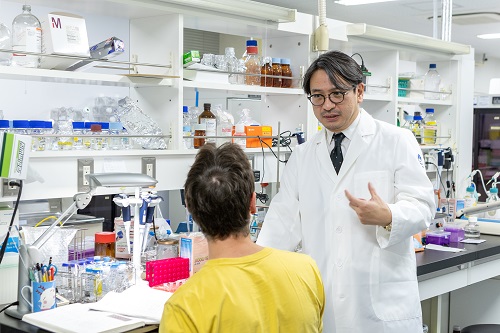
When you cannot explain well a phenomenon you are seeing or when you do not feel fully convinced, there is surely something wrong. An attitude of not running away from such dissatisfaction can lead to new findings.
A saying of his boss serves as his driving force: “If you see one phenomenon, continue to sit in front of it until you have written five papers on it.”
The research of Dr. Tasuku Honjo, who is the Nobel Prize laureate in Physiology or Medicine 2018, has opened up a new field of cancer treatment known as “cancer immunotherapy,” particularly, “PD-1 blockade therapy”. One drug used in this therapy is nivolumab (Opdivo).
Killer T cells typically do not attack unless they can recognize and identify other cells as their attack targets. This is another mechanism that prevents excessive immune response, and cancer cells can also take advantage of this mechanism to suppress the attackers. Cancer cells provide a “certificate” that they are not the attack targets as another means of escape. Killer T cells are slowed down and cannot show their ability to attack in the presence of this certificate. PD-1 blockade therapy including Opdivo has the function of nullifying this certificate, allowing killer T cells to attack cancer cells.
Cancer immunotherapy is a relatively new field of medicine. Unfortunately, PD-1 blockade therapy is only effective in 20% to 30% of eligible cancer cases, for some reasons not entirely explained. Dr. Nishikawa has proven one of the reasons.
“The immune system works properly in a positive and negative balance. I realized the phenomenon I encountered 20 years ago commonly underlied the results of my current work,” he said.
It has been shown that PD-1 blockade therapy activates not only killer T cells but also regulatory T cells surrounding cancer. Therefore, the key to the efficacy of the drug is the balance between the two types of T cells. If regulatory T cells in the periphery of cancer are strong, the killer T cells will eventually be outcompeted by them.
Dr. Nishikawa’s research progressed further, and the next step was to demonstrate exactly what determines the balance between killer and regulatory T cells. He turned his attention to cancer metastases in the liver, which are particularly resistant to PD-1 blockade therapy.
The liver is a metabolically active organ that receives abundant nutrients supplied from the digestive system such as the large and small intestines. The liver consumes a large amount of glucose to generate energy for metabolism, which results in the release of lactic acid. Cancer cells also consume high amounts of glucose to grow and divide. Metastatic cancer tissues in the liver are richer in lactic acid than other tissues.
“What I keep in my mind during my research on cancer immunology is to have both the viewpoints of cancer and immunity. I’ve noticed that regulatory T cells can utilize lactic acid, which hasn’t received attention in previous studies,” said Dr. Nishikawa.
Killer T cells and most other types of immune cells use glucose as an energy source for their activities, but they cannot use lactic acid. In an area where a large number of immune cells are accumulating and actively working, glucose levels decrease while lactic acid levels increase. In such an environment, regulatory T cells, which can utilize lactic acid, would not have any trouble obtaining an energy source, allowing them to constantly monitor and control immune responses.
Furthermore, Dr. Nishikawa has demonstrated that high levels of lactic acid slow down the activity of killer T cells; this suggests that metastatic cancer in the liver may be a more favorable environment for regulatory T cells than for other immune cells.
This series of discoveries has provided new insights into the study of cancer immunology, and has significantly impacted clinical practice. It is a great advance to identify patients who are not expected to respond to PD-1 blockade therapy, considering their cost and potential side effects.
Dr. Nishikawa has accomplished many studies, and describes himself as “being persistent” when it comes to his research, while attributing much of his success to advances in science and technology and to superior researchers who have supported him. His research attitude can be traced back to the time when he was a researcher at the Memorial Sloan-Kettering Cancer Center in New York, U.S., from 2003 to 2006. His boss at the time, Dr. Lloyd J. Old, was a renowned leader in the field of cancer immunology.
“He told me that when you see one phenomenon, continue to sit in front of it until you have written five papers on it. It’s pretty hard to write five papers, but I learned from him the attitude of doing as much as I can to solve a series of things,” said Dr. Nishikawa.

The immune system is purposeful, interesting, and beautiful.
When and how does the immune system find and recognize cancer cells? Does the judgment of whether or not something is foreign depending on the situation? Can we create killer T cells that can utilize lactic acid?
Questions arise in his mind one after another. The immune system is very complex, and much of it is still a mystery. Therefore, efforts may not yield fruitful results. “It’s daunting, and there’s so much I don’t understand yet, but that’s what makes it exciting,” Dr. Nishikawa stated. Each of his words sounds as if it conveys a spark of curiosity.
“While study immunology, I sometimes feel thrilled at such a complex but sophisticated mechanism present in our bodies, and the more I study, the more I am amazed and can only stand in awe of it. When I think something is wrong and research it again, I get exactly the results I was looking for. The immune system is so amazing that it makes me realize that human understanding is so far behind,” he said.
(Interview and Text: Tatsuro Ayatsuka, Interview Date: October 19, 2022)